


Hearing the Click but Feeling the Chill?
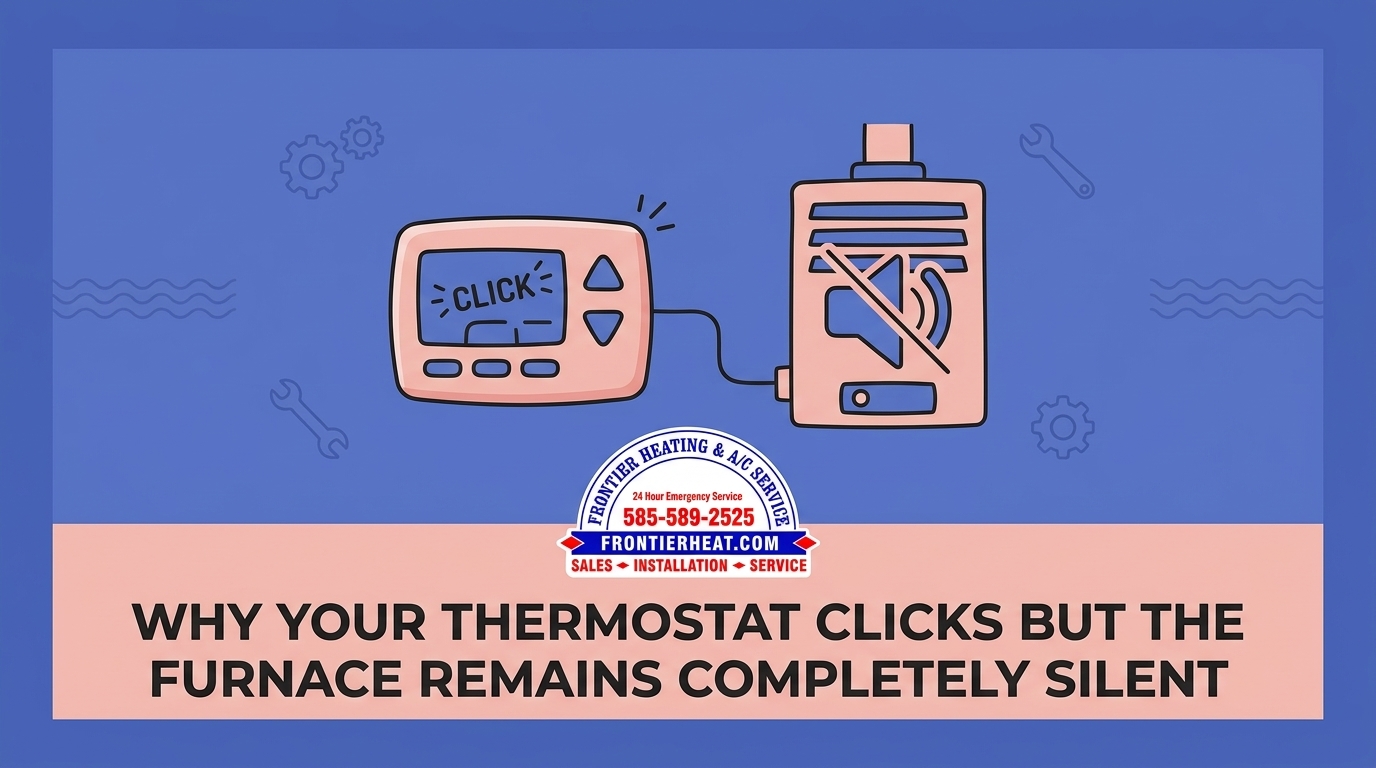
If you are wondering why your thermostat clicks but the furnace remains completely silent, you are not alone. You wake up to a chilly house, walk over to the wall, and turn up the heat. You hear that familiar, reassuring “click” from the thermostat. You wait for the rumble of the furnace kicking on, but nothing happens. The house stays cold, and the equipment remains dead quiet. In our years of performing October fall heating startups across Albion, our team at Frontier Heating & A/C Service, Inc. has found that this single click followed by total silence is one of the most common—and frustrating—symptoms homeowners face when turning their systems on for the season.
For fast, reliable help with this exact issue, you can explore our comprehensive HVAC services to get your system back on track.
Hearing the click without feeling the heat creates an immediate decision point. You need to figure out if this is a basic, safe fix you can handle yourself, or a complex electrical failure that requires a licensed professional. The most important thing to understand right now is that the click you hear is merely a communication attempt. It is not a guarantee of ignition. Your thermostat is trying to talk to the furnace, but somewhere along the line, the message is being dropped.
The Sequence of Operations: What That Click Actually Means
To understand why your system is ignoring you, it helps to know what is supposed to happen behind the scenes. When your home drops below the set temperature, a specific technical process begins. This sequence of operations relies on a delicate 24-volt control circuit to safely start your heating equipment.
Here is exactly what happens when your system operates correctly:
- The Thermostat Acts as a Switch: Your thermostat does not actually power the furnace. It acts as a gatekeeper. When the room gets cold, the thermostat decides it is time to close a switch and send a signal down the wire.
- The Relay Clicks: That audible click you hear from the wall is a small mechanical relay closing. This relay’s job is to pass the 24-volt control circuit signal down to the furnace control board.
- The Control Board Verifies Safety: Once the signal reaches the furnace, the control board takes over. Before it allows any gas to flow or any spark to ignite, it runs a rapid safety check. It verifies that all safety switches are closed and that the system is safe to operate.
- The Inducer Motor Starts: If the safety checks pass, the control board sends power to the inducer draft motor. This is usually the first sound you hear from the furnace itself—a small motor pulling air through the heat exchanger to vent exhaust gases.
If your furnace is completely silent, the sequence is failing between step two and step four. The signal is either never reaching the board, or the board is halting the process immediately due to a safety lockout or an internal failure. If you need an expert to trace this pathway, our furnace repair and service solutions are designed to pinpoint the exact breakdown in this sequence.
Safe Homeowner Checks to Perform First
Before you assume the worst about your 24-volt control circuit, there are a few safe, basic troubleshooting steps you should take. Often, an October fall heating startup reveals minor issues that developed while the system sat idle over the summer. You can safely check these items without any specialized tools.
- Check the main electrical panel: A furnace requires dedicated electricity to operate. Locate your home’s main circuit breaker panel and look for the breaker labeled for the furnace. If it is tripped (sitting in the middle position), firmly switch it completely off, then back on. A tripped breaker will cut all power, leaving the furnace completely unresponsive.
- Verify the blower compartment door is secure: Modern furnaces are equipped with a safety switch located on the blower compartment door. If this door is loose, bumped, or improperly seated after a filter change, the switch pops open. This immediately kills all power to the control board to prevent the blower from pulling in dangerous exhaust gases. Press firmly on the door to ensure it is fully seated.
- Inspect your thermostat batteries: If your thermostat relies on batteries rather than a hardwired connection, weak batteries can cause erratic behavior. Sometimes, dying batteries have just enough juice to close the relay (creating the click) but not enough sustained power to hold the 24-volt control circuit signal active. Swap in a fresh set of high-quality alkaline batteries.
| Symptom | Safe Check to Perform | Why It Matters |
|---|---|---|
| Total silence at the furnace | Inspect the main circuit breaker | Restores line voltage to the entire heating system. |
| Recent filter change, now silent | Press firmly on the blower door | Engages the vital door safety switch to restore power. |
| Faint click, blank screen | Replace thermostat batteries | Ensures a strong, continuous signal to the control board. |
The Danger Zone: Why DIY Electrical Testing is Risky
If you have checked the breaker, secured the blower door, and replaced the batteries, you have reached the boundary of safe homeowner troubleshooting. This is the danger zone. Moving beyond these basic checks means interacting directly with the 24-volt control circuit and the 120-volt line voltage that powers the system.
The Risks of Multimeter Testing
We strongly warn against homeowners using multimeters to test furnace control boards, transformers, or internal wiring. Modern heating equipment relies on highly sensitive, complex safety lockouts. Poking around a live control board without proper training can easily short out the board, instantly turning a minor repair into a major replacement. Furthermore, touching the wrong terminal can expose you to dangerous line voltage.
Warranty Implications
Attempting to bypass safety switches or test internal electrical components can also void your manufacturer’s warranty. Heating systems are designed with strict safety protocols for a reason. When a system locks down and goes silent, it is often doing exactly what it was engineered to do: protecting your home from an unsafe operating condition.
This is where professional expertise becomes critical. Frontier Heating’s expert technicians are trained to quickly and accurately diagnose complex electrical pathways between thermostats and furnace boards. They use specialized diagnostic tools to safely trace the voltage drop, ensuring the root cause is found without risking damage to the equipment or compromising your safety.

Common Internal Failures That Keep a Furnace Silent
When the basic checks do not resolve the issue, the silence is usually caused by an internal component failure that has severed the communication pathway. At Frontier Heating, our technicians typically see a few specific breakdowns within the 24-volt control circuit when we get called out to Albion homes.
Control Board Malfunctions
The control board is the brain of your heating system. It receives the signal from the thermostat, verifies safety conditions, and dictates the sequence of operations. Unfortunately, this brain can fail silently without warning. A common culprit is a blown low-voltage fuse on the board itself. This small automotive-style fuse protects the board from electrical shorts. If a wire rubs bare inside the cabinet and shorts out, the fuse blows instantly, cutting all communication. The thermostat will still click, but the board will remain dead. Diagnosing why the fuse blew—rather than just replacing it—requires professional electrical tracing. If the board itself is failing, it may also lead to erratic behavior, similar to a furnace blowing cold air at startup before shutting down.
Transformer Failures
Your furnace runs on two different voltages. The heavy lifting (like the blower motor) uses standard 120-volt line voltage. The communication (like the thermostat and safety sensors) uses a much safer 24-volt control circuit. The component responsible for stepping the high voltage down to the low voltage is the transformer. If the transformer burns out, the entire low-voltage side of the system loses power. The loss of this step-down voltage prevents any operational response. Your thermostat might click if it has its own batteries, but the furnace will be completely deaf to the signal.
Open Limit Switches and Safety Sensors
Furnaces are packed with safety sensors designed to detect overheating, proper venting, and flame rollout. If one of these sensors trips and fails to reset, it creates an open circuit. The control board sees this open circuit and refuses to proceed with the sequence of operations. The system locks down entirely, remaining silent to protect your home from a potential fire or carbon monoxide hazard.
Why Prompt Diagnostics Matter for Albion Homes
A silent furnace is a nuisance in mild weather, but it becomes an immediate emergency when the temperature drops. In Albion, NY, freezing late fall and winter temperatures make a non-responsive furnace a high-priority, urgent issue for homeowners. Our team routinely responds to these exact pre-winter emergencies.
When a heating system fails during a deep freeze, indoor temperatures plummet rapidly. A well-insulated home might hold its heat for a few hours, but soon the cold creeps into the walls and floors. The secondary risks of a silent heating system are severe. If the temperature inside the walls drops below freezing, water pipes can freeze and burst, causing extensive and catastrophic water damage to the home.
This is why prompt, professional intervention is critical. One local homeowner experienced a complete furnace failure when the weather outside was a bitter 7 degrees. A technician arrived just thirty minutes after the call, quickly assessed the completely dead system, and diligently installed a new furnace. The new equipment was placed and working within hours, securing the home against the freezing temperatures and preventing pipe damage. When the weather turns harsh, you cannot afford to wait on a silent furnace.
Evaluating Your Silent Furnace: Repair or Replace?
Once a technician diagnoses why your system is ignoring the thermostat, you will face another decision: repair the broken component or replace the entire unit. Assessing the long-term viability of your silent heating system requires a careful look at its age, condition, and repair history.
If your system is relatively new and the issue is a single blown fuse caused by a loose wire, it is a straightforward, quick repair. For example, during a sudden winter malfunction, a technician was dispatched immediately to evaluate a silent system. They quickly identified the specific electrical fault and fixed the issue within forty-five minutes, restoring heat reliably.
However, if you are dealing with frequent electrical failures on an older system, it may indicate the need for an upgrade. A fried control board or a burnt-out transformer on an aging unit requires a serious cost-benefit analysis. Sinking money into major electrical components on a furnace that is nearing the end of its lifespan is rarely a wise investment. A professional assessment provides clarity on the most reliable path forward, helping you determine if it is time for a furnace replacement.
| Condition | Likely Recommendation | Reasoning |
|---|---|---|
| System under 10 years old, single blown fuse | Repair | Minor electrical short easily isolated and fixed. |
| System over 15 years old, fried control board | Replace | High cost of repair on a system near end-of-life. |
| Repeated transformer failures | Assess for Replacement | Indicates deeper, systemic electrical issues in the unit. |
Expert Answers to Your Silent Furnace Questions
Why does my thermostat click but no heat comes on?
The click indicates your thermostat is closing a relay to send a signal, but a break in the communication line prevents the furnace from receiving it. This is usually caused by a tripped circuit breaker, an open blower door safety switch, or a failure within the furnace’s 24-volt control circuit. The thermostat is doing its job, but the furnace is unable to respond.
What causes a furnace to be completely silent?
A completely silent furnace has lost all electrical power or is locked down by a safety mechanism. Common culprits include a tripped main electrical breaker, a blown low-voltage fuse on the control board, a failed transformer, or an open blower compartment door switch that cuts power to the entire unit.
How do I know if my furnace control board is bad?
A bad control board often results in a completely unresponsive system, erratic cycling, or a failure to initiate the inducer draft motor. Because the board manages the entire sequence of operations, diagnosing it requires a professional technician using a multimeter to trace voltage drops and rule out other safety switch failures first.
Why is my furnace not responding to the thermostat?
Your furnace will ignore the thermostat if the 24-volt control circuit is interrupted. This interruption can happen if the thermostat wire is damaged, if the furnace transformer has failed, or if an internal safety sensor (like a limit switch) has tripped and locked the control board out of its starting sequence.
Can a dead thermostat battery cause a silent furnace if it still clicks?
Yes, weak thermostat batteries can cause this exact symptom. Dying batteries may have just enough remaining energy to mechanically close the relay (making the click sound), but lack the sustained voltage required to hold the signal open and communicate with the furnace control board.
Is it safe to test furnace fuses and transformers myself?
No, testing internal furnace fuses and transformers requires interacting with both the 24-volt control circuit and dangerous 120-volt line voltage. Without proper training and diagnostic tools, you risk severe electrical shock, shorting out the expensive control board, and potentially voiding your manufacturer’s warranty.
Restore Your Heat with a Professional Diagnosis
A clicking thermostat paired with a completely silent furnace is a clear sign that the communication pathway has broken down. While you can safely check your circuit breakers, blower door, and thermostat batteries, any issue beyond that requires expert electrical diagnostics. Especially during the critical October fall heating startup, guessing at the root cause can lead to dangerous conditions or expensive equipment damage. Stop struggling with a cold house and let a professional safely trace the 24-volt control circuit. Contact a licensed HVAC technician today to schedule a thorough inspection and get your heating system running reliably again.


