


Surviving July in Albion: Is Your Non-Stop A/C Normal or Failing?
Wondering why your Albion home’s A/C runs non-stop during July heatwaves (and when to actually worry) is a common stressor for homeowners facing peak summer temperatures in Western New York. You hear the compressor running outside, you feel air moving through the vents, yet the second floor of your house still feels uncomfortably warm. It is incredibly frustrating to listen to your cooling system work overtime while you are still sweating in your own bedroom.
Understanding this relentless cooling cycle is the key to protecting your equipment and your peace of mind. The most important decision point you face right now is determining if this continuous operation is simply a normal response to extreme weather, or if it is the early warning sign of a failing compressor. Local climate conditions and the specific architecture of your home play a massive role in how your system behaves under heavy load.
Whether you need comprehensive HVAC Services to get your system back on track or targeted repairs for your Air Conditioning in Albion, knowing the difference between normal strain and mechanical breakdown can save you a tremendous amount of stress.
The Architectural Challenge: Cooling Older Western NY Multi-Story Homes
To understand why your air conditioner is struggling, you have to look at the building it is trying to cool. In our years of experience at Frontier Heating & A/C Service, our team consistently sees that older Western NY and Albion multi-story homes were often built decades before modern central air conditioning standards existed. These beautiful, historic properties present unique physical and structural challenges that directly impact cooling performance.
When you try to push cold air through a home that was originally designed only to retain heat from a boiler or furnace, you run into several architectural roadblocks:
- The Stack Effect: Basic physics dictates that hot air rises and cold air sinks. In a multi-story home, the heat from the lower levels naturally pushes upward, collecting on the second floor. Your air conditioner has to fight this constant upward pressure of heat all day long.
- Insufficient Insulation: Many older properties lack modern, high-density insulation in the attic and exterior walls. Without this thermal barrier, the radiant heat from the summer sun easily penetrates the upper levels, forcing the cooling system to run longer just to maintain a baseline temperature.
- Missing Return Vents: Proper air conditioning requires a balanced cycle of supply and return air. Older ductwork retrofits frequently omit return vents on the second floor. Without a way to pull the hot, stagnant air out of the upper bedrooms and send it back to the cooling coil, the cold supply air simply pools downstairs.
- Balloon Framing: Some historic homes feature balloon framing, where wall cavities run continuously from the basement to the attic. This can act like a chimney for hot air, making the upper floors significantly harder to cool.
These structural factors mean that your air conditioner is not necessarily broken; it is simply being forced to run continuously to achieve a uniform temperature across a challenging layout.
The Hidden Enemy: How July Humidity Forces Your A/C Into Overdrive
When the weather forecast predicts severe heat, we naturally focus on the temperature. However, the real culprit behind continuous A/C operation in Western New York is the moisture in the air. High humidity fundamentally changes how your cooling equipment operates, and understanding this difference is crucial for troubleshooting.
Sensible Cooling vs. Latent Cooling
Your air conditioner performs two distinct jobs. Sensible cooling is the process of lowering the actual temperature of the air—the number you see on your thermostat. Latent cooling is the process of extracting invisible moisture (humidity) from the indoor air. The system handles latent cooling by drawing warm, moist indoor air over the freezing-cold evaporator coil, causing the moisture to condense into water and drain away.
The Heavy Toll of Moisture
During peak July heatwaves and humidity spikes, the air inside your home becomes incredibly heavy with moisture. Before your air conditioner can even begin to lower the sensible temperature in the room, it has to wring all of that excess water out of the air. In extreme conditions, a standard residential cooling system can spend up to 50% of its total energy and running time just dealing with latent heat.
This high moisture load masks proper A/C function. You might walk past a vent, feel cool air, look at the thermostat, and wonder why the temperature hasn’t dropped in three hours. Homeowners frequently assume their system is failing, when in reality, the equipment is functioning exactly as designed—it is just trapped in a prolonged dehumidification cycle.
Breaking the Cycle
If your system is constantly battling moisture, the most effective solution is to stop relying on your air conditioner to do a dehumidifier’s job. Integrating Whole House Dehumidifiers directly into your ductwork removes the heavy latent cooling load before the air ever reaches your A/C coil. This allows your air conditioner to focus entirely on lowering the temperature, resulting in shorter run times, less mechanical wear, and a much more comfortable home.
The 20-Degree Rule: Understanding Normal A/C Limits During Heatwaves
One of the most common misconceptions about central air conditioning is that it can achieve any temperature you set on the thermostat, regardless of the weather outside. This is simply not how residential cooling systems are engineered. Setting realistic baseline expectations is the first step in determining if your continuous running is a problem.
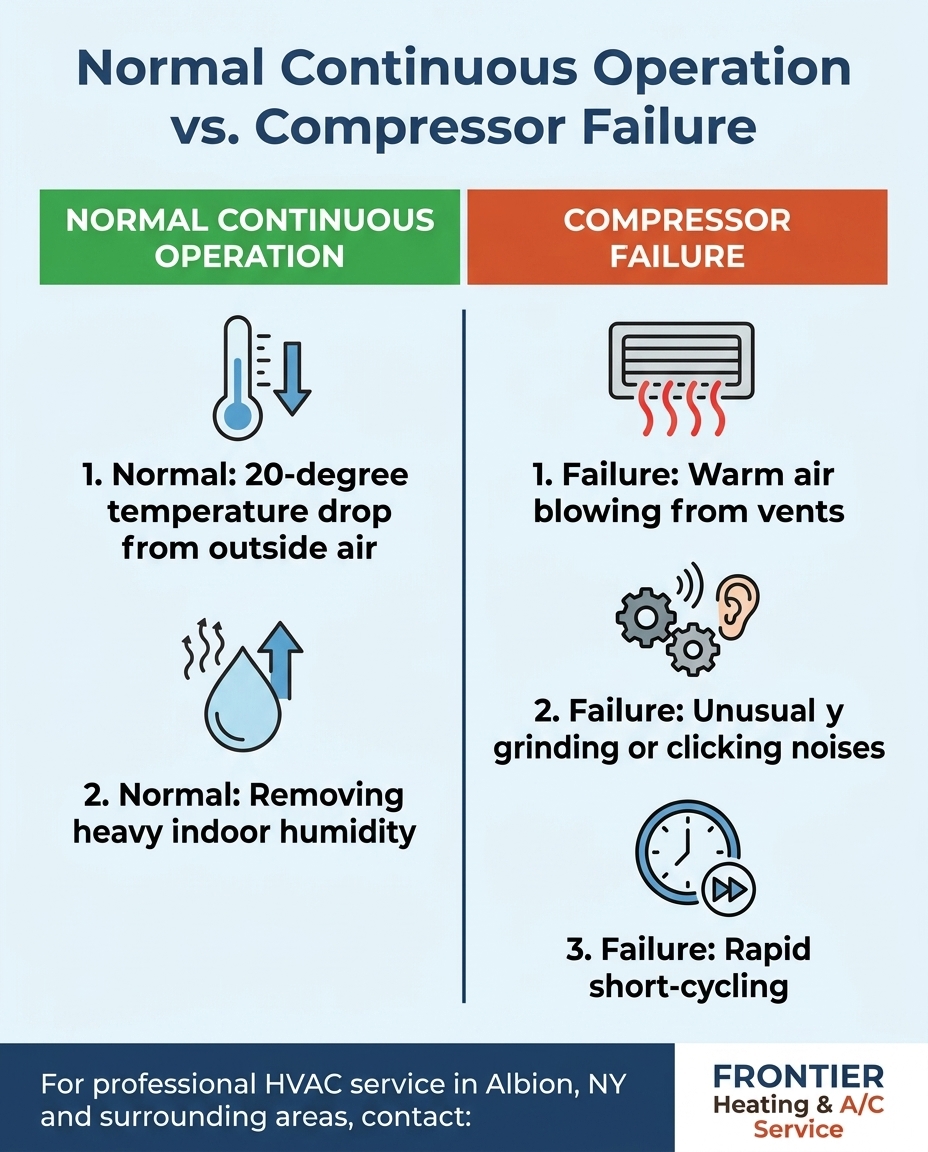
According to Department of Energy (DOE) guidelines and standard HVAC engineering practices, residential air conditioners are designed to maintain a maximum 20-degree temperature differential from the outdoor air. The system is sized to handle the average summer high for your specific climate zone, not the absolute worst-case scenario.
If you set your thermostat to 68 degrees during peak July heatwaves and humidity spikes when it is 95 degrees outside, your air conditioner will never reach that goal. It will run non-stop, consuming massive amounts of electricity, until the sun goes down and the outdoor temperature drops.
Expected Performance Under Heavy Load
| Outdoor Temperature | Maximum Expected Indoor Temperature Drop | Realistic Indoor Thermostat Setting |
|---|---|---|
| 85°F | 20°F Drop | 68°F – 72°F |
| 90°F | 20°F Drop | 70°F – 74°F |
| 95°F | 20°F Drop | 75°F – 78°F |
| 100°F | 20°F Drop | 80°F (System will run continuously) |
The takeaway: If it is 95 degrees outside and your indoor temperature is holding steady at 75 degrees, your system is actually functioning perfectly at 100% capacity. Continuous running under these specific extreme conditions does not inherently mean the system is breaking; it means it is working exactly as hard as it was designed to work.
When to Actually Worry: Telltale Signs of Compressor Failure
While continuous operation can be entirely normal during a heatwave, there is a clear line between a system working hard and a system actively failing. If your unit is running non-stop but failing to meet the 20-degree differential, or if it is exhibiting strange behaviors, the continuous running is likely due to a mechanical failure—most commonly involving the compressor.
For example, one local homeowner recently reached out to our Frontier Heating & A/C Service team during a summer heatwave when temperatures were in the 90s and their air conditioning unit stopped working completely. One of our technicians responded quickly, diagnosed a failing component that had been struggling for days, and repaired the unit in short order. Catching these signs early is critical.
Warning Signs You Shouldn’t Ignore
- Warm air at the registers: If the system is running constantly but the air blowing from the vents feels lukewarm or room temperature, the compressor is likely not engaging, or you have a severe refrigerant leak.
- Unusual mechanical noises: A healthy A/C hums steadily. If you hear loud grinding, clanking, metallic screeching, or repetitive clicking from the outdoor unit, the compressor motor is struggling to start or has internal mechanical damage.
- Tripped circuit breakers: If your system runs for a while and then suddenly trips the breaker at the electrical panel, the compressor is pulling too much amperage. This is a major red flag for electrical failure.
- Rapid short-cycling: Unlike normal continuous running, short-cycling is when the system turns on for two minutes, shuts off, and immediately turns back on. This puts immense strain on the compressor and signals a critical airflow or pressure problem.
Because the compressor is the heart of your cooling system and operates under high voltage and high pressure, diagnostics require a licensed professional. This is never a DIY project. If you notice any of these symptoms, you can read our detailed guide on the Warning Signs Your AC Compressor Is Failing to understand the next steps.
Why Your System Runs Constantly But the Upstairs Stays Hot
If you have ruled out a failing compressor, but your system still runs non-stop while the second floor remains sweltering, you are likely dealing with an airflow or sizing issue. Older Western NY / Albion multi-story homes are notorious for this specific imbalance.
Restricted Airflow: The most common culprit for uneven cooling is a dirty air filter. When the filter is clogged with dust and pet hair, the blower motor cannot pull enough air through the system. The cold air lacks the velocity to reach the second-floor vents, causing it to dump into the first-floor rooms instead. Blocked supply vents (covered by rugs or furniture) create the same bottleneck.
Undersized Equipment: If your air conditioner was not properly sized for the square footage and layout of your home, it simply lacks the cooling capacity and blower power to push conditioned air upstairs. An undersized unit will run 24/7 during a heatwave and still fail to cool the upper levels.
Thermostat Location: The thermostat only reads the temperature of the air immediately surrounding it. If your thermostat is located in a naturally cool, shaded hallway on the first floor, it will sense that the target temperature has been reached and shut the system off long before the second floor has cooled down. Conversely, if it is placed near a heat source, it will force the system to run constantly, overcooling the first floor while trying to satisfy a false reading.
These issues are systemic, meaning they require ductwork modifications, zoning solutions, or a professional load calculation rather than an emergency compressor repair.
Tailored Solutions to Reduce Cooling Strain in Western NY Homes
You do not have to simply accept a constantly running air conditioner and a hot second floor. There are proactive, tailored solutions that can significantly reduce the strain on your cooling system. A customer located in the Village of Albion recently called us with serious AC concerns during a hot week; our Frontier Heating & A/C Service technicians arrived quickly and provided prompt, polite, and knowledgeable service to get the system back up and running by addressing these exact types of strain.
Here are the most effective steps to protect your system:
- Prioritize Professional Maintenance: An air conditioner cannot operate efficiently if its internal components are filthy. Signing up for an HVAC Maintenance Plan ensures that your condenser coils are chemically cleaned, blower motors are calibrated, and refrigerant levels are exact. Proper refrigerant charge is critical; even a slightly low charge will cause the system to run continuously.
- Utilize Air Circulation: Combat the stack effect by keeping internal doors open to promote airflow. Use ceiling fans (set to rotate counterclockwise) to push cold air down from the ceiling and create a wind-chill effect on your skin, allowing you to comfortably raise the thermostat a few degrees.
- Reduce the Sensible Load: Keep your blinds and curtains closed during peak sun hours, especially on south- and west-facing windows. Blocking radiant heat from entering the home prevents the indoor temperature from spiking, giving your A/C a much-needed break.
- Manage Indoor Air Quality: As a local team with deep expertise servicing older Albion homes, we at Frontier Heating & A/C Service know that generic A/C replacements don’t always solve the root problem. Integrating dedicated humidity control solutions addresses the specific regional challenges of Western NY, drastically reducing the latent cooling load on your primary air conditioner.
Get Peace of Mind for Your Albion Home’s Cooling System
The relentless heat of summer can make any homeowner anxious about their cooling equipment. While it is completely normal for an air conditioner to run continuously to combat extreme humidity and maintain a 20-degree differential, ignoring the actual warning signs of mechanical failure can lead to costly and uncomfortable breakdowns.
Cooling older Western NY / Albion multi-story homes requires a strategic approach, not just raw cooling power. If you are tired of listening to your system struggle, or if you suspect your compressor is showing signs of distress, a professional assessment can definitively diagnose the issue. Do not wait until the system fails completely—explore your options and schedule a comprehensive check-up before the next heatwave peaks, ensuring your home stays comfortable all summer long.
Frequently Asked Questions
Is it normal for AC to run constantly in 90 degree heat?
Yes, it is often completely normal for an air conditioner to run continuously when outdoor temperatures exceed 90 degrees. Residential cooling systems are designed to maintain a 20-degree difference between the indoor and outdoor air. If it is 95 degrees outside and your home is holding steady at 75 degrees, the system is working at its maximum designed capacity and will need to run constantly to maintain that temperature.
Why is the upstairs so hot when the AC is running?
Heat naturally rises due to the stack effect, making the second floor inherently warmer than the first. In many older homes, the ductwork lacks adequate return vents on the upper levels to pull the hot air out. Additionally, restricted airflow from dirty filters or an undersized blower motor can prevent the cold supply air from reaching the upstairs rooms effectively.
Will my AC break if it runs all day?
Running all day will not immediately break a well-maintained air conditioner, as they are built to handle heavy summer loads. However, continuous operation does increase the wear and tear on moving parts like the compressor and blower motor. To prevent premature failure during long heatwaves, it is crucial to keep your air filters clean and ensure the outdoor unit is free of debris.
What are the signs of a failing AC compressor?
The most obvious sign of a failing compressor is warm or lukewarm air blowing from your vents while the system is running. You may also hear unusual mechanical noises from the outdoor unit, such as loud grinding, screeching, or repetitive clicking. Rapid short-cycling—where the unit turns on and off every few minutes—is another critical warning sign that requires immediate professional attention.
How does humidity affect my air conditioner’s performance?
High humidity forces your air conditioner to work significantly harder because it must remove the moisture from the air before it can effectively lower the temperature. This process, known as latent cooling, can consume up to 50% of the system’s energy during peak summer days. Consequently, heavy humidity causes the air conditioner to run much longer cycles just to make the home feel comfortable.


